
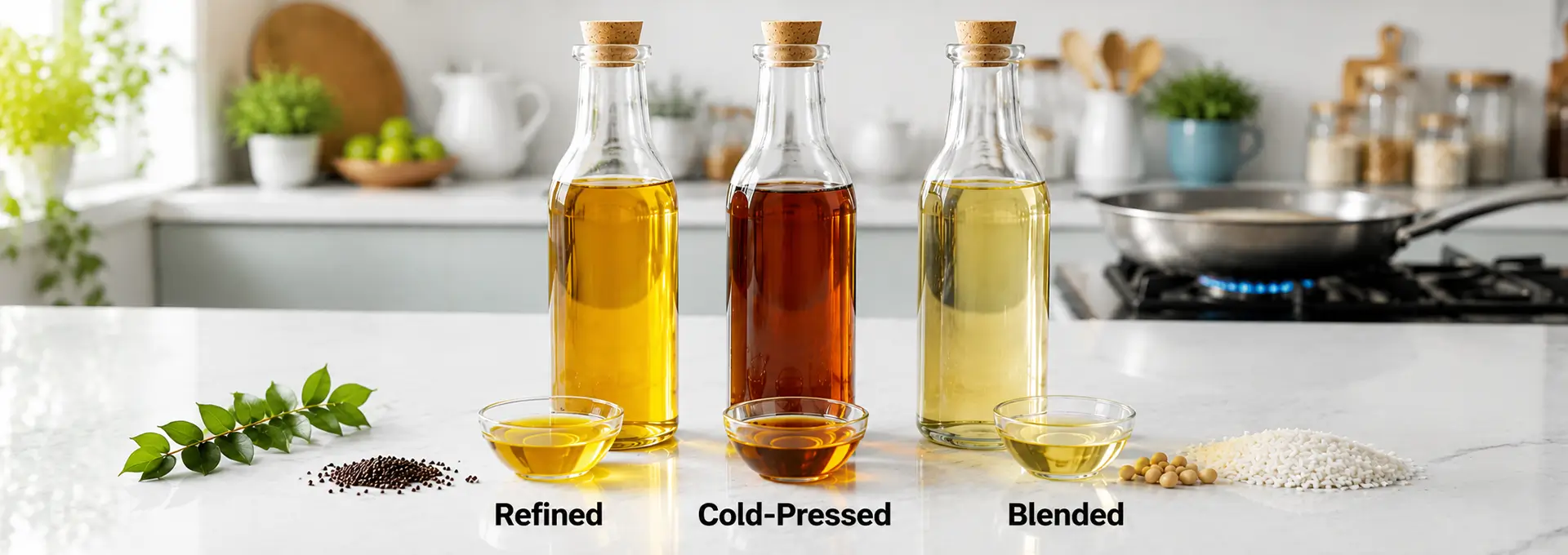
Blended Vs Refined vs Cold-Pressed Oil: Key Differences and How Each Affects Your Cooking
The oil you cook with every day quietly shapes your family’s health, yet it is one of the least examined choices in most Indian kitchens. Refined, cold-pressed, blended: the supermarket shelf offers all three, and the labels rarely explain what actually separates them. This guide breaks down how each oil is made, how that affects how it behaves on your stove, and how to choose the one that fits your cooking and health goals.
Understanding the Three Types of Cooking Oils
Before making a cooking oil comparison, it’s better to understand how each cooking oil is made and what its benefits are.
What Is Refined Oil?
Refined oil is extracted using heat and solvents, then treated through processes to produce a neutral, stable oil. It offers a high smoke point and long shelf life, making it practical for everyday cooking. The trade-off is that intensive processing strips away most natural vitamins, antioxidants, and phytonutrients.
What Is Cold-Pressed Oil?
Cold-pressed oil is extracted purely through mechanical pressing, no heat, no solvents. This preserves the oil’s natural colour, flavour, and nutritional compounds. Cold-pressed oil benefits include higher levels of vitamin E, polyphenols, and antioxidants. However, the lower smoke point makes these oils better suited to dressings, light sauteing, and finishing rather than high-heat Indian cooking.
What Is Blended Oil? The Best of Multiple Oils in One
A blended cooking oil combines two or more oils to balance their individual strengths, achieving an optimal fatty acid profile, a high smoke point, and enhanced nutrition in a single bottle. A well-formulated blend is a deliberate, science-led formulation.
How Oil Processing Directly Affects Your Cooking?
Processing does not just affect what is inside the bottle, it changes how the oil performs in your kitchen.
Smoke Point: Why It Matters for Indian Cooking Methods
The smoke point is the temperature at which an oil breaks down, releasing harmful free radicals. Indian cooking involves tadka, deep frying, and high-flame stir-frying that demands a high smoke point. Refined and blended oils typically exceed 200°C, making them safe for these methods. Cold-pressed oils, with lower smoke points, are unsuitable for high-heat cooking.
Flavour: How Oil Processing Shapes the Taste of Food
Cold-pressed oils carry the robust, natural flavour of their source, for example, mustard oil’s pungency, sesame oil’s nuttiness. Refined oils are neutral, letting spices and ingredients speak for themselves. Blended cooking oils sit in the middle: mild and versatile, with occasional subtle notes from their component oils.
Nutrient Retention During Cooking
Cold-pressed oils are nutritionally richer in the bottle, but degrade quickly if heated beyond their smoke point. Refined oils offer little nutritional value to begin with. A quality blended oil built on a physically refined base like rice bran oil strikes the best balance, stable under heat and meaningfully nutritious.
Refined vs Cold-Pressed vs Blended Oils: Key Differences at a Glance
| Feature | Refined Oil | Cold-Pressed Oil | Blended Oil |
|---|---|---|---|
| Processing | Heat and chemical solvents | Mechanical pressing only | Combination of oils |
| Flavour | Neutral | Strong, characteristic | Mild to moderate |
| Nutrient Retention | Low | High | Moderate to high |
| Smoke Point | High (200–250°C) | Low to medium (150–190°C) | High (200–250°C) |
| Shelf Life | Long | Shorter | Moderate to long |
| Best Use | Deep frying and high-heat cooking | Dressings and low-heat cooking | Everyday Indian cooking |
Why Are More Indian Households Choosing Blended Oils?
No single-source oil delivers every fatty acid the body needs. A blended cooking oil can be engineered to provide the right MUFA-to-PUFA ratio, incorporate beneficial plant compounds from multiple sources like oryzanol, lignans, omega-3s and in some cases, be fortified with vitamins. It offers the nutritional breadth of several oils alongside the practicality of one, making it the best cooking oil for health-conscious Indian households.
Why Is Fortune Xpert a Smart Choice for Modern Kitchens?
Fortune Xpert oil is built around a clear philosophy that each variant should serve a specific health goal, formulated by nutritional science rather than cost reduction.
Physically Refined Rice Bran Oil: The Xpert Foundation
Every Fortune Xpert variant is anchored in physically refined rice bran oil that is processed via steam distillation rather than chemical solvents, preserving what makes it exceptional.
- Retains natural oryzanol: a plant compound that actively manages cholesterol.
- High smoke point (~250°C): safe for all Indian cooking methods.
- Lowers LDL, raises HDL cholesterol: supporting cardiovascular health daily.
Three Variants, Three Health Goals: Choose Your Xpert
| Variant | Composition | Designed For |
|---|---|---|
| Fortune Xpert Total Balance Oil | Rice bran 35% + Soyabean 60% + Flaxseed 5% | Heart health |
| Fortune Xpert Pro Immunity Oil | Rice bran 70% + Sunflower 30% + Vitamins A, D & E | Immunity boost |
| Fortune Xpert Pro Sugar Conscious | Rice bran 80% + Sesame 20% (unrefined) | Blood sugar management |
Vitamin Fortification in Pro Immunity: Rare in Indian Cooking Oils
Fortune Xpert Pro Immunity adds Vitamins A, D, and E, fat-soluble nutrients that are most effectively absorbed through dietary fat. Delivering them via cooking oil is both logical and efficient, making this a genuinely functional, healthy cooking oil.
Filtered Sesame in Sugar Conscious Preserves Active Lignans
Filtered sesame oil retains sesamin and sesamolin, lignans associated with improved insulin sensitivity. Refining would destroy them entirely. Keeping the sesame unrefined ensures the health benefit is real.
Blended for Health Targets: Not Just Cost Reduction
Many blended oils on the market are blended to reduce cost, not to improve nutrition. Fortune Xpert reverses this logic, and every ratio is chosen for its health outcome.
Light, Digestible, Suitable for All Ages
Fortune Xpert oil is light in texture, easy to digest, and flavour-neutral, making it suitable for children, elderly family members, and everyone in between.
How to Choose the Right Oil for Your Needs?
With so many options available, the right question is not “which oil is best?” but “which oil is best for me?” Your cooking habits, health priorities, and taste preferences all play a role in finding the ideal match.
Based on Your Cooking Style
For high-heat methods like frying, tadka, and curries, choose a blended oil with a high smoke point. Fortune Xpert Total Balance and Fortune Xpert Pro Immunity Oil handle all standard Indian cooking with ease.
Based on Your Health Goals
Heart health calls for Total Balance, immunity support points to Pro Immunity, and those managing blood sugar will find Sugar Conscious the most thoughtfully designed option.
Based on Taste Preferences
All Fortune Xpert variants are largely neutral in flavour. Those who enjoy a subtle nuttiness will find Fortune Xpert Pro Sugar Conscious Oil, with its unrefined sesame component, particularly appealing.
Refined oils offer practicality; cold-pressed oils offer nutrition, and a well-engineered blended cooking oil offers both. Fortune Xpert goes further by formulating each variant around a specific health goal, built on a physically refined rice bran base that no standard cooking oil can match.
Match your kitchen to the right variant. Explore the Fortune Xpert range and find the oil built for your health goal.
FAQs
What is the difference between refined oil and cold-pressed oil?
Refined oil uses heat and solvents for stability. Cold-pressed oil is mechanically extracted, retaining vitamins and antioxidants, but with a lower smoke point, it suits light cooking rather than high-heat methods.
Which cooking oil is best for Indian cooking: refined, cold-pressed, or blended?
A quality blended cooking oil is the most practical choice, combining a high smoke point with a balanced fatty acid profile. Fortune Xpert is specifically formulated for the demands of Indian kitchens.
What is a blended cooking oil and why is it good for health?
It combines two or more oils to achieve a fatty acid balance that no single oil can offer, delivering MUFAs, PUFAs, and beneficial plant compounds in proportions that support heart health and overall wellbeing.
Is blended cooking oil good for diabetes?
Yes, when formulated correctly. Fortune Xpert Sugar Conscious Oil blends rice bran oil with unrefined sesame oil, whose active lignans are associated with improved insulin sensitivity and glycaemic control.
Which oil is best for heart patients in India?
Physically refined rice bran oil, rich in oryzanol, is widely recommended. Fortune Xpert Total Balance, further enriched with flaxseed omega-3s, is an excellent everyday choice for cardiovascular health.
How does Fortune Xpert oil differ from regular cooking oils?
Unlike oils blended for cost efficiency, Fortune Xpert is engineered around health goals anchored in physically refined rice bran oil and formulated with specific outcomes, heart health, immunity, and blood sugar management.